Home → Waste Management → Programs → Hazardous Waste/Universal Waste → Hazardous Waste Handbook
Universal Waste Handbook Appendices
- Appendix A - Universal Waste Flow Chart
- Appendix B - Department Universal Waste Notification Form
- Appendix C - Universal Waste Log Form
- Appendix D - Weekly Inspection Checklist for Universal Waste Storage Areas
- Appendix E - Quarterly Universal Waste Report Forms
- Appendix F - Quarterly Report Alternative Form A & B
- Appendix G - Small Universal Waste Generator Cleanup Plan
- Appendix H – Architectural Paint Clean-Up Plan
- Appendix I - Uniform Bill of Lading (sample blank form)
- Appendix J - Maine Universal Waste Transport & Identification Information
- Appendix K - Uniform Bill of Lading (sample completed forms)
- Appendix L - Excerpts of Universal Waste Rules
Appendix A - Universal Waste Flow Chart
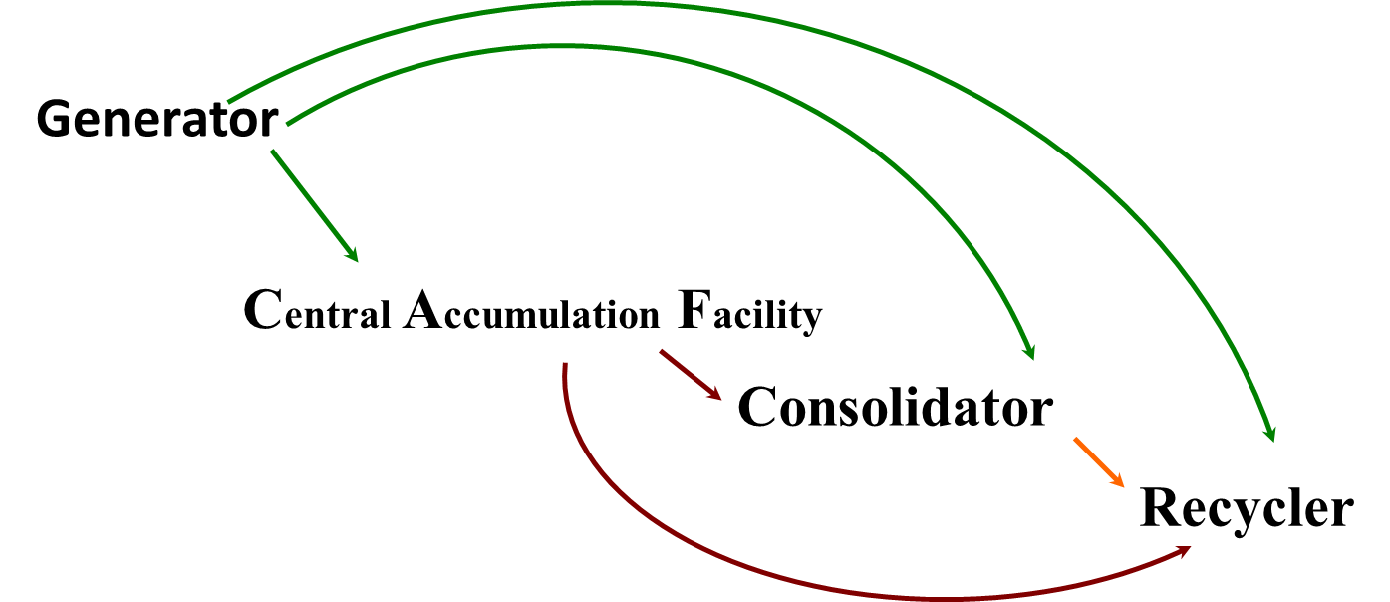
The image above describes the flow of universal waste items downstream starting with the generator and ending with the destination of the waste being the recycler. The generator has several options to manage universal waste, including disposal at a central accumulation facility or a consolidator, or shipping them directly to the recycler. A central accumulation facility can ship items to a consolidator or recycler, and a consolidator can ship to the recycler. Universal waste items can never go upstream in this flow system (e.g., a consolidator can’t give items to a central accumulation facility) except when a generator owned central accumulation facility gives items to a transfer station owned central accumulation facility.
Appendix B - Universal Waste Notification Form
Appendix C - Universal Waste Log Form
Universal Waste Log Form (Part 2B) for Transfer Stations and Recycling Centers
Appendix D - Weekly Inspection Checklist for Universal Waste Storage Areas
Appendix E - Quarterly Universal Waste Report
Quarterly Universal Waste Report
Quarterly Universal Waste Report Form A
Quarterly Universal Waste Report Form B
Quarterly Universal Waste Report Form C
Quarterly Universal Waste Report Form D
Appendix F - Quarterly Report Alternative Form A & B
Alternative Quarterly Report Format for Form A&B in Appendix E
Alternative Quarterly Report Example for Form A&B Appendix E
Appendix G - Small Universal Waste Generator Cleanup Plan
CAUTION!
Spills and releases of universal waste can be hazardous to your health.
If you do not feel confident with your ability to safely clean up a discharge of universal waste, it is recommended that you hire a professional environmental contractor to conduct the cleanup.
Reporting Requirements:
Report spills/discharges of universal wastes to the Department’s spill hotline at 1-800-452-4664. The exception, you do not need to report spills/discharges of the following:
Cathode ray tubes: Incidental spills/releases of ten (10) or fewer CRTs.
Lamps: Incidental spills/releases of ten (10) or fewer lamps.
All spills/discharges from batteries, mercury-containing thermostats, mercury devices, motor vehicle mercury switches and PCB ballasts must be reported immediately.
Procedures
The following procedures can be used to clean up universal wastes:
- Always wear safety glasses and disposable rubber gloves when cleaning universal waste spills. All items (i.e. brooms, shovels, scoops, tape, gloves, sponges, rags…) used to clean up universal waste spills should be considered contaminated and must be decontaminated or treated as waste.
- Thoroughly wash your hands and face after cleaning up any universal waste spills.
For spills or releases that do not require reporting:
- place the broken universal waste item(s) in an appropriate container i.e. sealable plastic bag or sealable plastic or metal container;
- scoop or wipe up as much of the discharged material as possible and place the rags and any other clean-up equipment in the container;
- wipe the spill area thoroughly with a wet sponge. For mercury lamps, it is recommended that you go over the area with masking tape to pick up small particles of mercury. Place sponge, tape, and/or rags in an appropriate container;
- seal the container(s) and store as universal waste.
- if the spill occurred on a carpet or other permeable surface it may be necessary to remove the flooring to prevent continued exposure to universal waste. This debris should be considered contaminated and treated as hazardous waste.
For spills or releases that require reporting:
- Follow the same instructions as above, except the waste must be managed as a hazardous waste instead of as a universal waste.
Special Precautions for Mercury Spills:
- For All Mercury-Containing Spills: When a mercury spill occurs, the immediate area should be blocked off to prevent any accidental tracking of the mercury. The heat should be reduced and cooling and ventilation increased in the spill area. There are clean-up kits on the market that can be purchased if you are handling any mercury items. You may also put your own kit together.
- Avoid skin contact with mercury or surfaces that have been contaminated with mercury and make sure to remove all jewelry that may come in contact with the mercury.
- Do not use a vacuum to clean up mercury or lead spills.
The use of a vacuum on a mercury or lead-containing universal waste spill will cause mercury and lead dust to be dispersed into the air or will cause the liquid mercury to stick to the metal parts in the vacuum motor. This will allow the mercury and lead to be discharged every time the vacuum is used. This poses a serious health problem and should be avoided. In addition, the vacuum will have to be decontaminated or discarded due to mercury contamination.
Special vacuums are available from environmental contractors that may be used on a mercury spill. - For Spills of Liquid Mercury
Due to the need for specialized equipment and testing of the contaminated area, it is recommended that a professional environmental contractor is hired for all liquid mercury spills.
This spill clean-up plan is offered as an aid for the smaller universal waste generators. Other generators may also utilize this plan if it is helpful to them.
Appendix H - Architectural Paint Clean-Up Plan for PaintCare Collection Sites
Spills
The information in this section will assist with spills from damaged or leaking Program containers. It is important that all Drop-Off Site staff understand corrective actions to minimize exposure to people or the environment.
- Collection Bins should be kept in a clean, accessible area. Clean up any spill or release of Program Product immediately and place spill residue in a sealed container (you may use the PaintCare provided spill kit container for this).
- Label the sealed container “Waste Paint - paint spill waste”, and place sealed container in a Collection Bin.
- Contact the Hauler or PaintCare to replenish spill kit materials as needed.
Reporting
Report any spill or release of ten (10) gallons or more of oil-based Program Product outside of primary containment.
- Immediately call the Maine Emergency Response System at (800) 452-4664.
- Report the spill/release within 15 days using the Hazardous Waste & Hazardous Material Spill or Discharge Report Form
- Contact PaintCare within 24 hours of making such a report.
Spill Kits
PaintCare provides each Drop-Off Site with a spill kit containing: latex gloves, safety glasses, absorbent, and plastic bags.
- Any material used should be replaced immediately. Contact your assigned hauler for replacement items.
Spill Response Procedures
If a spill is less than 10 gallons and small enough to be managed by Drop-Off Site staff, follow these steps:
- Isolate the area and restrict access to the spill
- Ensure personal safety, put on protective gear (glasses and gloves) provided in the spill kit
- Stop the movement of paint by placing the leaking container upright or in a position where the least amount will spill, and place leaking container in plastic bags provided in spill kit, or into the spill kit container
- Contain the spill by placing absorbent pads or granular absorbent around and on the spill – if outdoors, place barriers around storm drains to prevent a release to the environment
- Collect the contaminated absorbent material and place it in a plastic bag(s) or spill kit container, along with the leaking container and contaminated PPE, seal the bag(s) and place in the Collection Bin
- Remove any clothing that may be contaminated, wash thoroughly to remove spilled material from your hands or body
- Replace any used spill control supplies
- Document the date, location and amount and type of material spilled, and retain this record for a minimum of 3 years.
If the spill is 10 gallons or greater, or cannot be managed by Drop-Off Site staff, contact a licensed hazardous waste contractor for clean-up assistance.
Appendix I - Uniform Bill of Lading (sample blank form)
Appendix J - Maine Universal Waste Transport and Identification Information
| Waste Type | DOT Proper Shipping Name | UNIT CODE | WASTE CODE(S) |
|---|---|---|---|
| Ni-Cad batteries, dry | Non-DOT regulated materials, (Ni-Cad, dry), for recycle as universal waste | BT | MRD006 |
| Ni-Cad batteries, wet | UN2795, Batteries, wet filled with alkali, 8, PGIII | BT | MRD002 MRD006 |
| Nickel Metal Hydride | Non-DOT regulated materials, (NiMH, dry), for recycle as universal waste | BT | MRD002 |
| Mercuric oxide batteries | UN2025, Mercury compounds, Solid, n.o.s. (mercuric oxide), 6.1, PGIII | BT | MRD009 |
| Magnesium batteries | UN3077, Environmentally hazardous substance, solid, n.o.s. (magnesium compounds), 9, PGIII | BT | MRD007 |
| Lithium metal batteries (including lithium alloy batteries) (3) | UN3090, Lithium metal batteries including lithium alloy batteries, 9, II | BT | MRD003 |
| Lithium metal batteries (including lithium alloy batteries) (3) | UN3091, Lithium metal batteries contained in equipment including lithium alloy batteries, 9, II | BT | MRD003 |
| Lithium metal batteries (including lithium alloy batteries) (3) | UN3091, Lithium metal batteries packed with equipment including lithium alloy batteries, 9, II | BT | MRD003 |
| Lithium-ion button batteries (typical for watches and calculators) (3) | UN3480, Lithium-ion batteries including lithium ion polymer batteries, 9, II | BT | MRD003 |
| Lithium-ion button batteries (typical for watches and calculators) (3) | UN3481, Lithium-ion batteries contained in equipment including lithium ion polymer batteries, 9, II | BT | MRD003 |
| Lithium-ion button batteries (typical for watches and calculators) (3) | UN3481, Lithium-ion batteries packed with equipment including lithium ion polymer batteries, 9, II | BT | MRD003 |
| Silver oxide batteries (common in watches) | Non-DOT regulated materials, (dry battery), for recycle as universal waste | MRD011 | |
| Small Sealed Lead Acid Batteries (1) | Non-DOT regulated materials, (SSLA battery), for recycle as universal waste | MRD002 MRD008 |
|
| Alkaline batteries (common AAA, AA, D and C cell batteries) | Batteries, dry, not subject to the requirements of the subchapter | P (pounds) | NONE |
| Mercury contained in manufactured articles (4) | RQ, UN3506, Mercury contained in manufactured articles, 8, 6.1, PG II | TH = thermostats; MD = mercury devices (including switches and thermometers); MS = motor vehicle switches | MRD009 |
| PCB Ballasts (if reason to believe over the RQ) | RQ, UN2315, Polychlorinated biphenyls, liquid, 9, PGII | PC | MRM002 |
| PCB Ballasts (not over the RQ) | UN3082, Environmentally hazardous substances, liquid, n.o.s., 9, PGIII | PC | MRM002 |
| Non-PCB Ballasts for Recycle | Non-Regulated Ballasts for Recycling | P (pounds) | None |
| Flat Panel Displays (Household Waste Stream) |
Non-DOT regulated materials, (Flat Panel Display), for recycle as universal waste | CR | MRD008 |
| CRT’s | Non-DOT regulated materials, (cathode ray tube), for recycle as universal waste | CR | MRD008 |
| Lamps (2) | Non-DOT regulated materials, (insert type of lamp), for recycle as universal waste | H | MRD009 |
| Electronic Devices (including circuit boards) | Non-DOT regulated materials, (circuit boards), for recycle as universal waste | ED | MRD008 |
| Paint Care Waste Paint | UN1263, Paint Related Material, 3, PG II, DOT-SP 11624 (Universal Waste) | P (pounds) | MRD001 |
Note (1) Small sealed lead acid batteries manufactured after 9/30/1995 must be plainly and durable marked “NONSPILLABLE” or “NONSPILLABLE BATTERY” to be transported as Non-DOT regulated. Otherwise these types of batteries need to be transported as “UN2794, Batteries, Wet, Filled with Acid, 8, PGIII”
Note (2) Types of lamps include but are not limited to: fluorescent tubes, neon and high intensity discharge (HID) which includes: mercury vapor, high-pressure sodium vapor and metal halide bulbs
Note (3) These changes have been made in the Hazardous Materials Table (49 CFR § 172.101) for US DOT – PHMSA and will impact generators of universal waste batteries in that these two types of lithium batteries will have to be segregated and each battery will have to be in its own enclosure or terminals covered.
Note (4) The prefix notation of “RQ” to this DOT shipping description should only be added if the total weight of mercury being shipped exceeds one (1) pound. The subsidiary hazard class of 6.1 only needs to be added if the manufactured articles contain more than eleven (11) pounds.
Please note that the batteries described as “Batteries, dry, not subject to the requirements of this subchapter” and “Non-DOT Regulated Materials (battery description) for recycle as universal waste” must be securely packaged and offered for transportation in a manner that prevents the dangerous evolution of heat (for example, by the effective insulation of exposed terminals) and protects against short circuits (see 49 CFR 172.102, Special Provision 130).
Appendix K - Uniform Bill of Lading (sample completed forms)
Appendix L - Excerpts of Universal Waste Rules
- Ch. 858 (Word) Universal Waste Rules
- Ch. 851 (Word) Standards for Generators of Hazardous Waste (Section 9)
- Ch. 853 (Word) Licensing of Transporters of Hazardous Waste
- Ch. 857 (Word) Hazardous Waste Manifest Requirements (Section 4)