March 24, 2026 at 12:25 pm
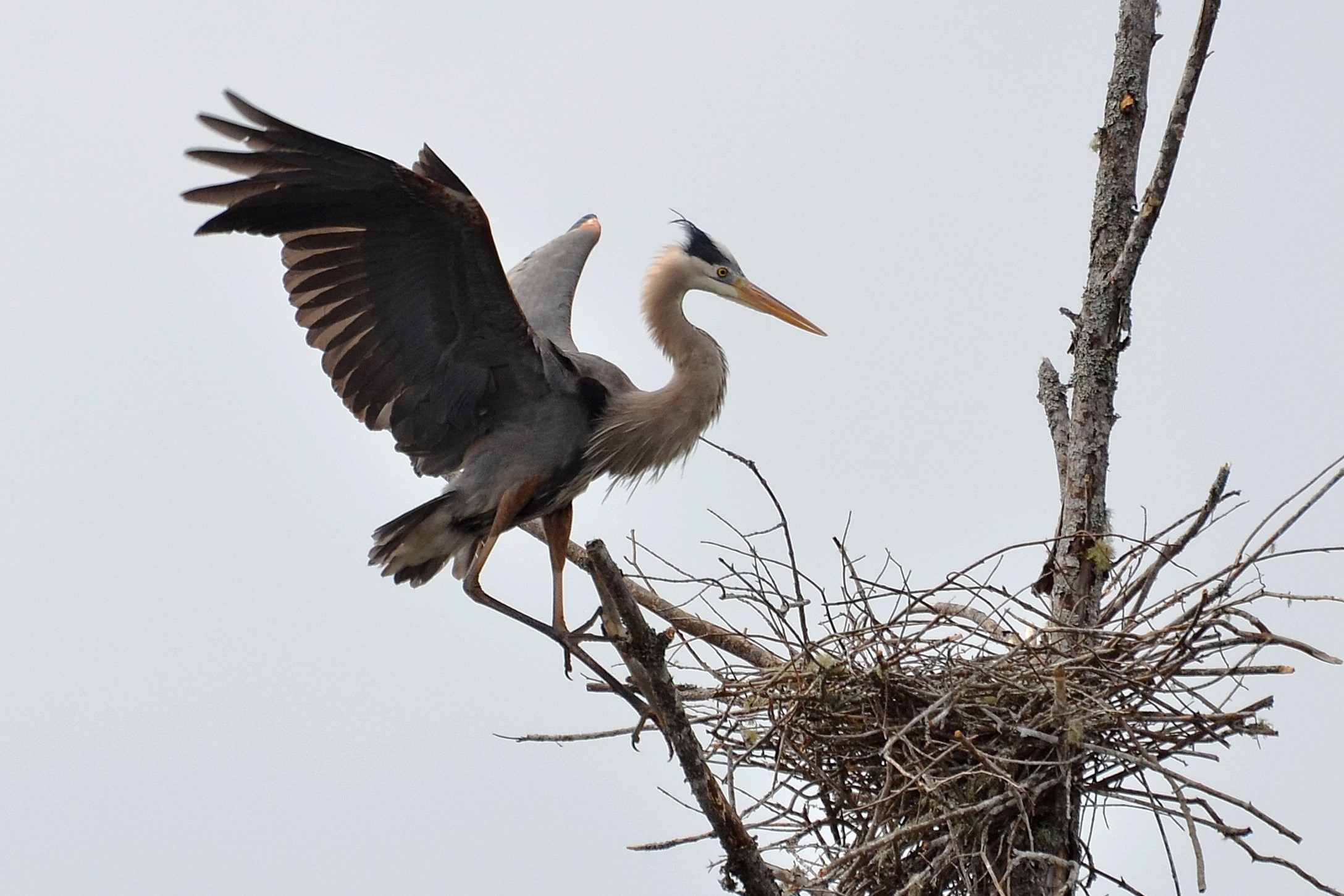
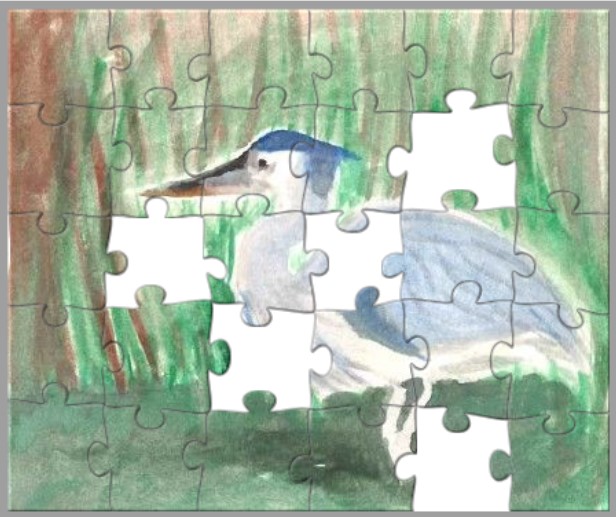
The Heron Observation Network (HERON) is currently MDIFW’s primary tool for understanding Maine’s Great Blue Heron population. Every year since 2009, 60-100 volunteers venture out across Maine during peak biting insect season to peer through binoculars and spotting scopes in hopes of seeing Great Blue Herons occupying large stick nests in trees. They count the number of nests, the number of adults at those nests, and later in the season, the number of fuzzy heads poking up from within. By repeating these visits year after year, volunteers have helped piece together how our Great Blue Herons are faring. But the puzzle is not complete without additional pieces such as standardized aerial surveys conducted in 2015 and 2023, as well as Bird Atlas efforts in 1978-1983 and 2018-2022. Data from Maine’s two breeding bird atlases, conducted nearly four decades apart, provided a unique opportunity to assess long-term changes in distribution and abundance, and relate those changes to more recent trends detected through our HERON efforts.
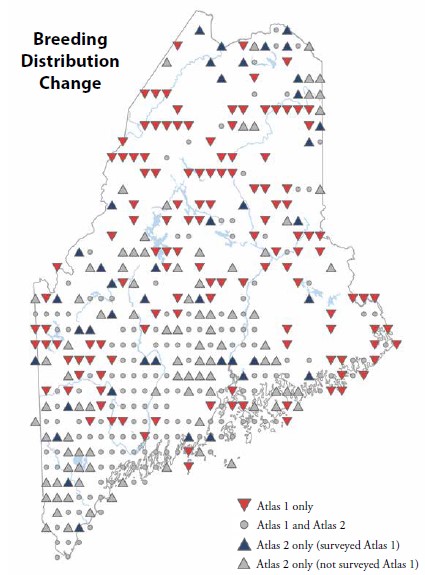
Atlas 2 is now considered the most comprehensive dataset ever collected for Maine birds. Over 6,500 volunteers participated and recorded nearly 2 million observations of 332 species in just five years. Volunteers recorded 1,746 observations for Great Blue Herons in 590 blocks (the state was divided into 4,080 blocks, each about 8.5 square miles) and identified previously undocumented colonies. Atlas 2 confirmed that Great Blue Herons remain broadly distributed across Maine, nesting in diverse habitats such as beaver flowages, coastal islands, upland pine stands, and even man-made structures, but also revealed regional declines since the first atlas, especially in eastern and northern parts of the state. In fact, the Great Blue Heron showed a -21% range retraction from Atlas 1 to Atlas 2. These findings corroborate data from standardized aerial surveys, as well as ongoing colony monitoring through the Heron Observation Network. Combined, these efforts reveal a statewide population decline of over 30% between 2009 and 2022, with especially steep losses among island-nesting birds along the coast.
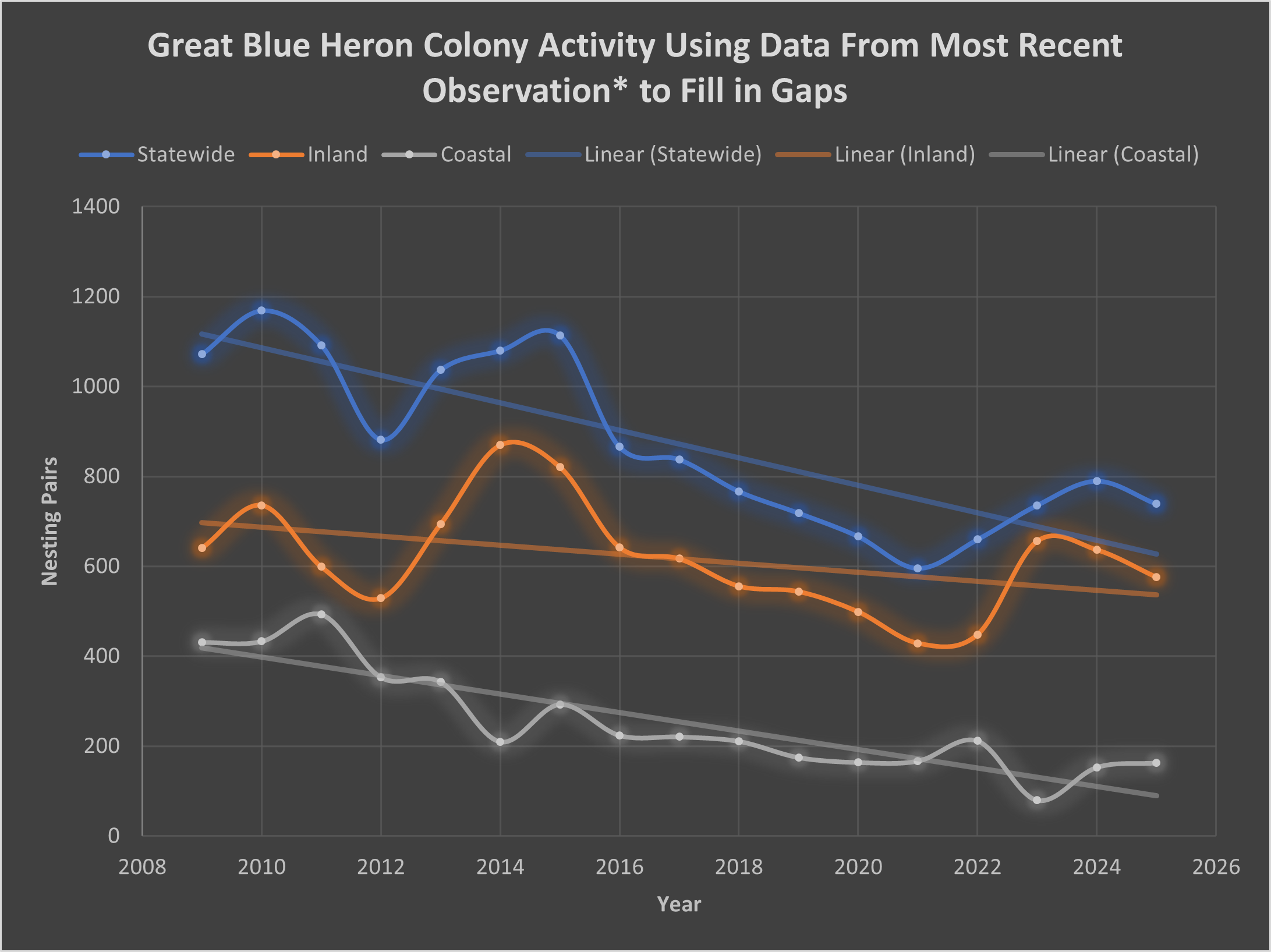
After Atlas 2, the Heron Observation Network has continued to collect data on Great Blue Heron colonies, and the results are more of the same. In 2025—the 17th year of the community science program—71 volunteers and a few staff monitored 100 Great Blue Heron colonies via ground surveys. At least 159 ground visits were conducted by volunteers, tallying 313 hours and 5,322 miles. Of these 100 colonies surveyed, 56 were active with at least 575 nesting pairs. The graph below illustrates the fluctuations in the population since 2009, with some increases here and there. The overall trend from 2009-2025 shows nesting Great Blue Herons declined 31% statewide and 62% along the coast, thus not much has changed in the few years since the completion of Atlas 2.
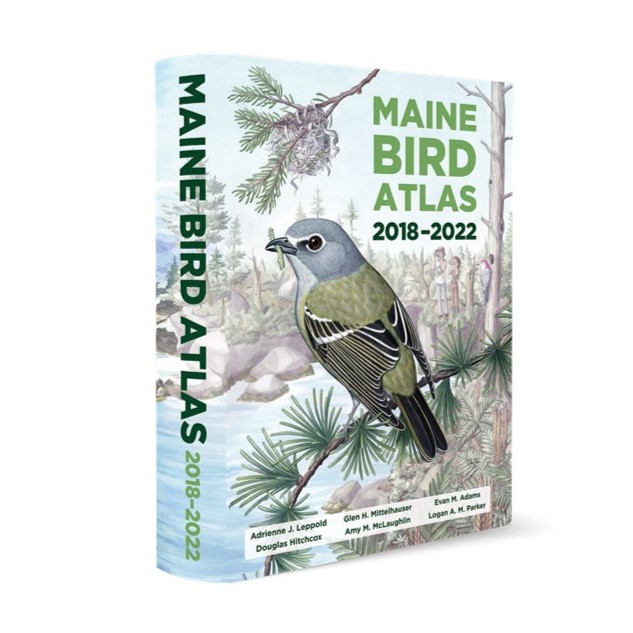
be published sometime this fall.
Several other interesting tidbits about Maine’s Great Blue Herons can be found in Atlas 2, which will be published and available to the public this fall! As with all species documented during Atlas 2, there is a species account for the Great Blue Heron that details its breeding range and phenology, abundance, population change, and wintering distribution. There is a phenology chart revealing the timeline of their nesting stages. Maps illustrate where they were documented during breeding and wintering, and specific areas from which they have disappeared since Atlas 1.
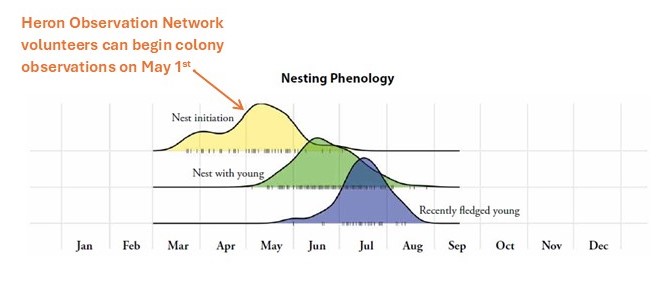
As we embark on the 18th year of the Heron Observation Network, it is important to recognize that this year is just as important as the last—and the first. It is another key piece to the puzzle that contributes to the larger picture. In my mind, the work to date has not only completed the outer edge of the puzzle but also started filling in the full image. Each year and each survey effort is one more piece that reveals not only the updated population status but creates a more complete picture that can guide our conservation efforts going forward.